
Making things happen
A feed of scripted posts only goes so far. Often you want things to happen while the participant is there: someone mocks a post three minutes in, a bystander steps in, the bully answers whoever replies to him.
Each of those is a beat. A beat says what sets it off, who does what, and in which conditions. The part of Truman that runs them is called Christof, the director, and every decision Christof makes is recorded and ends up in your export.
Where beats are written
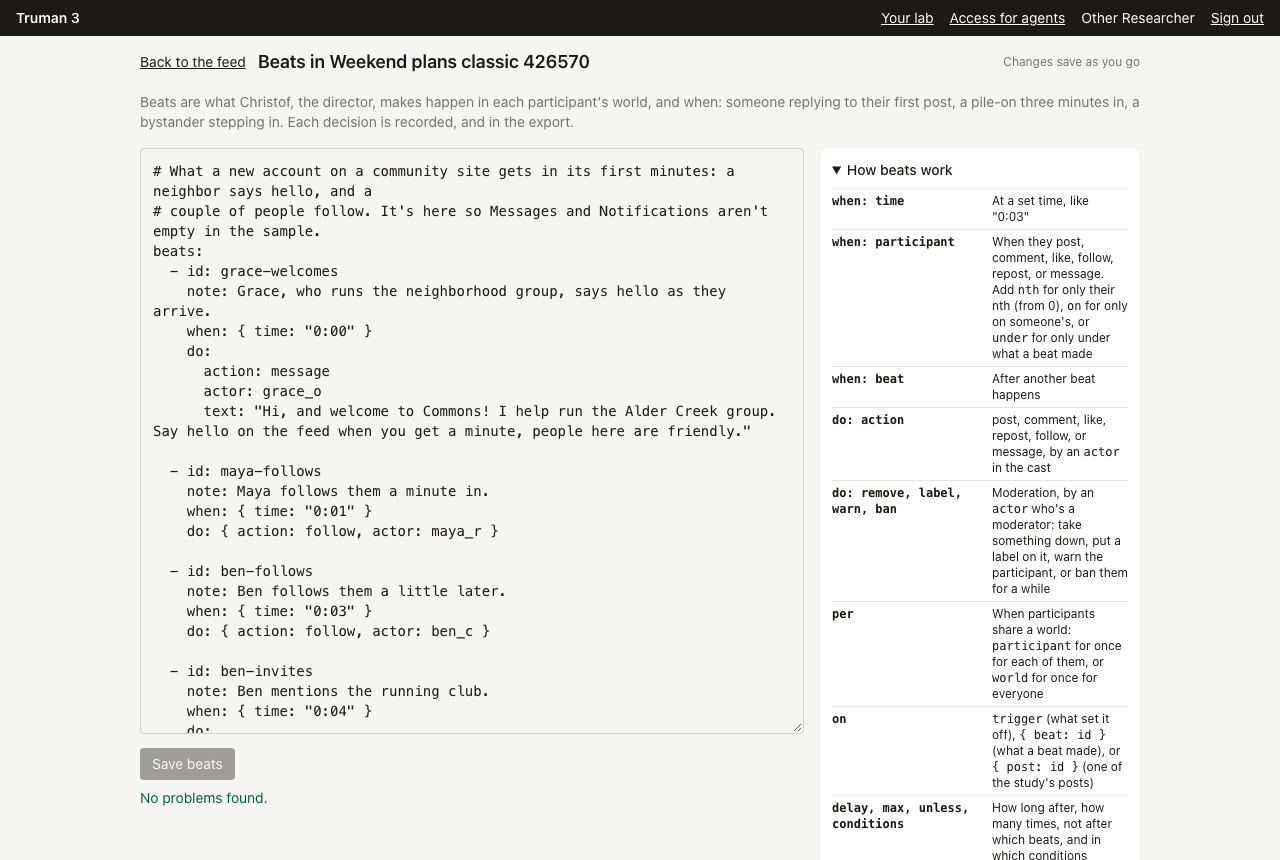
In the builder, press Beats. The page has a text editor, with a reference table called How beats work beside it. A study with no beats shows one to start from.
Beats are written as text, in a format called YAML: indented lines of name: value. The easiest way to start is to copy an example, change the values, and press Save beats. The page says No problems found, or names the beat and what's wrong with it, such as a person who isn't in the cast.
A first beat
Here's a small one to start with. Someone replies to the participant's first post, a minute or two later:
beats:
  - id: welcome
    note: Someone replies to the participant's first post.
    when: { participant: post, nth: 0 }
    delay: { min: "0:01", max: "0:02" }
    do:
      action: comment
      actor: grace_o
      on: trigger
text: Welcome! Glad you're here.idnames the beat, in lowercase letters, numbers,-and_.noteis for your team. Participants never see it.whenis what sets it off.delayis how long after, as one time or a range. Times are hours:minutes.dois what happens.actoris a username from your cast.
What sets a beat off
Give exactly one when:
when | Happens |
|---|---|
{ time: "0:03" } | Three minutes after the participant starts |
{ participant: post } | When they post. Also comment, like, follow, repost, and message |
{ participant: comment, nth: 0 } | Only on their first comment. nth counts from 0 |
{ participant: comment, on: maya } | Only when it's on something Maya wrote |
{ participant: comment, under: jake-mocks } | Only on what the beat jake-mocks made, or anywhere under it |
{ beat: jake-mocks } | After that beat happens |
What happens
action | Does |
|---|---|
post | A new post, with text |
comment | A comment, with on and text |
like, repost | A like or a repost of on |
follow | Follows the participant |
message | A direct message to the participant. Needs direct messages on |
remove, label, warn, ban | Moderation by someone in the cast. Each needs its feature on |
on says what it's done to:
triggeris whatever set the beat off: what the participant wrote or acted on, or what the beat before made.{ beat: jake-mocks }is what that beat made.{ post: maya-art }is one of the study's own posts, by itsidin the posts sheet.
Limits on a beat
Three optional settings narrow down when a beat happens:
conditions: [silent]makes it happen only in those conditions. Leave it out for all.max: 3lets it happen up to three times in one participant's world. The default is once.unless: [sam-defends]cancels it if any of those beats has happened by the time it's due.
A scene
Beats get more interesting when they refer to each other. This scene is cut down from the bystander example. Jake mocks a painting. In defended, Sam steps in a minute or more later, unless the participant has already answered Jake.
beats:
  - id: jake-mocks
    when: { time: "0:03" }
    do:
      action: comment
      actor: jake
      on: { post: maya-art }
      text: lol my little brother paints better than this

  - id: sam-defends
    conditions: [defended]
    when: { beat: jake-mocks }
    delay: { min: "0:01", max: "0:03" }
    unless: [jake-answers-participant]
    do:
      action: comment
      actor: sam
      on: { post: maya-art }
      text: Not cool, Jake. It's her first painting. Maya, I love the colors!

  - id: jake-answers-participant
    when: { participant: comment, under: jake-mocks }
    delay: { min: "0:01", max: "0:02" }
    do: { action: comment, actor: jake, on: trigger, text: "relax, it's a joke" }
A delay in a range is drawn at random, the same way each time for the same world. If the participant is away when a beat comes due, it's still placed at the time it was due, and they find it there on their next visit.
What's recorded
Every time Christof considers a beat in someone's world, it becomes a row in beat_runs.csv: what set it off, when it was due, whether it happened, and if it didn't, why. A beat that needs something that's off in a condition, like comments, is skipped there and the reason is written down.
Check that it works
Beats are logic, and logic has paths you didn't think of. Before launch, go through the study as a test participant, write a scenario test for each path that matters, and send in simulated participants to find beats that never happen. All of that is in Testing a study.
Words that aren't fixed
The lines in a beat don't have to be written ahead of time. A comment can have improvise in place of text: an instruction for an AI model that writes the line in that character's voice. A beat can also wait for you to approve its line before it posts. Both are in A cast that writes for itself.
Decision points
Beats decide what happens inside a condition. A decision point decides which condition someone is in, partway through. Use one for an adaptive design, where people who haven't posted by the end of day 2 are re-randomized to a stronger nudge.
Decision points go under decide: on the Beats page:
decide:
  - id: day-2
    when: { time: "48:00" }
    conditions: [gentle-nudge]
    measure:
      posts: { count: post }
    groups:
      - name: non-responders
        if: { posts: { atMost: 0 } }
        to: { strong-nudge: 1, peer-nudge: 1 }
      - name: responders
        to: stay
A measure counts something the participant did, such as posts, comments, likes, or minutes active. Groups are checked in order, and the first that fits decides. to either re-randomizes by weight or says stay.
A condition that's only reached this way has a weight of 0 in Settings, so nobody starts in it. Every assignment, including staying, is recorded with its probability in assignments.csv, so a standard SMART analysis can weight it.
Not in shared worlds yet
Decision points aren't available in shared worlds yet. For how beats behave there, see Several real people together.